|
Q:
|
Sluggish Beardie
|
|
In Relation To:
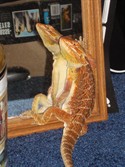
Bandit
|
|
|
Our beloved beardie, Bandit, has been acting pretty sluggish the past week or so. He would stay in his hut all day or just lay in the same spot. I don't believe he has even eaten any of his greens. We did eat some crickets earlier in the week but he was pretty lazy when it came to those also. He usually runs around chasing them but this time he kind of just sat there and waited for them to come to him. Nothing has recently been changed to his set-up, and all the temps and lights have reamained the same. I am wondering if he has possibly decided to brumate on his own or if there is something seriously wrong with him?! If he is brumating is there anything I need to do differently? Please help!!! I am worried bout my lil monster! Thank you all kindly.
|
|
Member Comment
|
2/20/2010 8:29:47 PM
|
|
Geckofactor
|
|
How old is he? What kind of setup is he in? Has anything changed recently? Is he still having regular bowel movements? Heating, lighting etc.
|
|
|
|
|
|
|
|
Member Comment
|
2/20/2010 8:35:19 PM
|
|

Sparkle
|
|
Well, since you are in Illinois, he may be "hibernating" because it is winter! I have a beardie book and it says that it is normal for them to be sluggish and sleep a lot in the winter. They will eat less and move less. Even if you don't turn his heat down, they know it's winter. Mine is doing the same thing too...
|
|
|
|
|
|
|
|
Member Comment
|
2/21/2010 3:11:28 PM
|
|
|
|
|
|
|
Accepted Answer
|
2/22/2010 7:32:43 AM
|
|
Sparkle
|
See if you can pick up the book "The Bearded Dragon Manual" - I bought one when I got a bearded and it's very helpful.
http://www.amazon.com/Bearded-Dragon-Advanced-Vivarium-Systems/dp/1882770595/ref=sr_1_1?ie=UTF8&s=books&qid=1266841437&sr=1-1
Also, this online care sheet has information about winter brumation; apparently some of them just do it on their own without any changes to the habitat:
http://www.georgiabeardeddragons.com/bearded_dragon_care_information_manual.html
This is a natural occurring hibernation period considered necessary for a dragon to sexually mature and to induce breeding activity. Think of it as Mother Nature’s “Time Out”. Many bearded dragons will slow down their eating and activity during the winter months even without initiating any lighting or heating condition changes. One sign of your dragon wanting to brumate is it will stay on the cooler side of the tank, bask less, appear sleep, not eat much and stay in it's hide. You may winterize your dragons for approx. one to two months however some dragons will brumate on their own for as long as 3-4 months during their brumation cycle.
We suggest following the natural winter light cycle with a reduction of daylight hours by one to two hour each week over the winter months until you reach 8 hours of light per day which helps ease your dragon into the natural brumation period. A temperature drop should also occur gradually until the day temperature of the enclosure is between 75° and 80° F in the cool zone and night temperature may drop below 75° but not lower than 70° F. Before putting a dragon “down for winter brumation” be sure that your dragon is healthy, free of undigested food and has had a fresh bowel movement. It is also ideal to get your well check visit from your vet and a good worming routine done before putting a dragon into brumation. You can encourage your dragon to have a bowel movement by soaking him/her for approximately 10-15 minutes in gently mild warm water. In addition to having your dragon in a cooler tank we also cover the tank with a dark blue or black sheet for privacy and so that your dragon is not disturbed. Do not handle your dragon during brumation unless it is completely necessary.
If you notice your dragon getting up and about during the brumation cycle, small amounts of food can be offered. If your dragon does eat during the brumation cycle be sure to soak him or her again in a day or two to stimulate a bowel movement so the food does not sit and ferment in the stomach of your dragon while your dragon is brumating to prevent a parasite buildup. Provide your dragon with a den type area in which they can “retreat” for privacy to sleep during their brumation cycle. An upside down shoe box with a entrance cut out in it is ideal. Some will want to dig or burrow down. The best environment for a dragon in brumation is a cool, quiet, dark place. You can provide this simply by using a dark sheet loosely draped over the cage.
A heavy brumation period may not be necessary for many bearded dragons. When the winter period is over, slowly raise the temperature levels to the previously suggested highs and increase the photo-period (lighting level) until the light cycle is up to 12-14 hours per day.
|
|
|
|
|
|
|
|
Member Comment
|
2/22/2010 7:35:19 AM
|
|
Sparkle
|
|
The above is not so much for people who know what brumation is (I don't mean to imply you are ignorant!!) but I wanted the information there for new beardie owners who may be wondering the same thing, and who may find your question in a search. More information is better! :)
|
|
|
|
|
|
|
|
Member Comment
|
2/22/2010 5:15:52 PM
|
|

Aimee
|
|
http://www.amazon.com/Your-Bearded-Dragons-Life-Complete/dp/0761527710
this one is the bomb, although sometimes hard to find.
|
|
|
|
|
|
You are not logged in. If you would like to participate (it's free!), you must log
in, or Become a Member!
|
|
|
|
Most Popular Tags
Ball
,
Ballpython
,
Bci
,
Behavior
,
Boa
,
Breeding
,
Buying
,
Caging
,
Care
,
Chondro
,
Cornsnake
,
Crested
,
Crestedgecko
,
Eggs
,
Feeders
,
Feeding
,
Feedingproblems
,
Gecko
,
General
,
Genetics
,
GTP
,
Health
,
Heating
,
Humidity
,
Identification
,
Illness
,
Incubation
,
Infection
,
Leopardgecko
,
Mites
,
Morelia
,
Morph
,
Morphs
,
Parasites
,
Python
,
Regius
,
Respiratory
,
Shedding
,
Snake
,
Substrate
|
Latest Questions
|
|
|
|
points:150
|
|
|
|
points:100
|
|
|
|
points:250
|
|
|
|
points:100
|
|
|
|
points:250
|
More Questions
|
|
|
Latest Answers
|
|
|
|
points:250
|
|
|
|
points:150
|
|
|
|
points:100
|
More Answers
|
|
|