|
Q:
|
Blood during shedding?
|
|
If you ever looked closely at your snake's shed skin, you'll often see a small amount of dried blood, usually as two bilateral dots at the vent. I've observed this in both male and female snakes. I'm sure it's no cause for concern, but I'd be curious to know why it occurs. Any ideas?
Thanks,
Brad
|
|
Member Comment
|
8/8/2008 10:42:59 AM
|
|
Kaiyudsai
|
|
I think that's dried up crust from the scent glands...and not blood
|
|
|
|
|
|
|
|
Member Comment
|
8/8/2008 9:43:57 PM
|
|

MegF
|
|
I don't think it's blood either. It can't be removed from the shed.
|
|
|
|
|
|
|
|
Author Comment
|
8/9/2008 12:30:19 AM
|
|
bwaffa
|
|
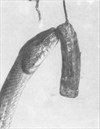
Sorry for the camera phone quality picture:
[img]http://gallery.me.com/bradleyjwaffa/100134/photo/web.jpg[/img]
I have no doubt it has something to do with the scent glands, but I'm almost certain it's blood. I saw the dots literally minutes after the shed occurred and it looked exactly like blood. Furthermore, I'm a 22 year old testosterone-driven male. I watch fight club like once a week. I eat red meat. Plus, I'm sure you saw the blog picture of my beard... come on. I definitely know what blood looks like.
Also, for what it's worth, I did a very informal experiment tonight and found that hydrogen peroxide took the dots right off... Hmm.
So here's the deal: to earn Aaron's magic points, one must either explain the blood, or offer a detailed alternative explanation with a solid physiological basis for what the substance is and why it occurs there.
The challenge has been offered and the stakes are high. Carpe diem, friends.
|
|
|
|
|
|
|
|
Author Comment
|
8/9/2008 12:31:26 AM
|
|
bwaffa
|
|
P.S. At least five points to anyone who can teach me how to insert a paragraph break into these durn things... Sorry for the jumbled paragraphs.
|
|
|
|
|
|
|
|
Member Comment
|
8/9/2008 2:04:14 AM
|
|

aaron
|
|
 Do you not have the rich text editor? What browser are you on? Do you not have the rich text editor? What browser are you on?
Here's your photo:
|
|
|
|
|
|
|
|
Member Comment
|
8/9/2008 3:28:12 AM
|
|

Katie M
|
|
even I know how to insert paragraphs! do the < br > but without the spaces in between the alligator mouths :)
|
|
|
|
|
|
|
|
Member Comment
|
8/26/2008 10:23:58 PM
|
|

BitterSweet
|
1) you can either paragraph break with "<br>" at the front of a line and "</br>" at the end (html coding is fun) OR you can shift+enter
2) I too have noticed the blood in greater quantenties the that on my ball python. It freaked me out when I first saw it since my ball was my first snake. I have since determined that it is normal. Think of it this way, when you skin peals on your hands and you pull it and it goes all the way to under your fingernails, you get a lil blood (at least i do). Or, as a testastron driven male might think of it, if your skin ever peeled on your "vent" woulnt you bleed just slightly?
With a younger snake it is more normal then in older snakes. But if you are noticing more blood more often, it could be possible parrisites.
|
|
|
|
|
|
|
|
Accepted Answer
|
9/20/2008 12:25:41 PM
|
|

Saffleur
|
Found this through google...
Snakes will normally rest during the start of their shed cycle, but will however be active at night to help push the dead skin off. In female ball pythons they will rub their gentiles around on the substrate to leave their pheromones in breeding season, this sometimes has a little blood in it but is normally triggered by an adult male. The reason is due to them inverting their cloaca. When a ball python sheds it also sheds its hemipenis, this may also cause a little blood.
|
|
|
|
|
|
|
|
Member Comment
|
9/20/2008 12:44:02 PM
|
|
MegF
|
|
Uh...shed it's hemipenss...it's shedding the sheath around the hemipenes...you can see that in a male python's shed, but it does not shed the hemipenes itself. I've seen the hemipenes sheath, but no blood on it. I've never noticed the "blood" spots on the male python's sheds.
|
|
|
|
|
|
|
|
Member Comment
|
9/29/2009 11:13:25 AM
|
|

dalvers63
|
|
This question has had no activity for 14 days and will be closed by an administrator unless the original poster takes action.
Recommended Action: Points awarded
An administrator will select responses and assign points at their discretion.
Original poster, please close this question out and assign points. If you have any further information in the resolution of your problem, please post it here so that others may learn from it.
|
|
|
|
|
|
|
|
Author Comment
|
10/6/2009 3:50:04 AM
|
|
bwaffa
|
|
Well, we never did determine WHY it happens, but I've seen it in other species too and it doesn't seem to be problematic. Therefore, I guess for now points go to Saffleur; as his Google source concluded -- it just happens!
|
|
|
|
|
|
You are not logged in. If you would like to participate (it's free!), you must log
in, or Become a Member!
|
|
|
|
Most Popular Tags
Ball
,
Ballpython
,
Bci
,
Behavior
,
Boa
,
Breeding
,
Buying
,
Caging
,
Care
,
Chondro
,
Cornsnake
,
Crested
,
Crestedgecko
,
Eggs
,
Feeders
,
Feeding
,
Feedingproblems
,
Gecko
,
General
,
Genetics
,
GTP
,
Health
,
Heating
,
Humidity
,
Identification
,
Illness
,
Incubation
,
Infection
,
Leopardgecko
,
Mites
,
Morelia
,
Morph
,
Morphs
,
Parasites
,
Python
,
Regius
,
Respiratory
,
Shedding
,
Snake
,
Substrate
|
Latest Questions
|
|
|
|
points:150
|
|
|
|
points:100
|
|
|
|
points:250
|
|
|
|
points:100
|
|
|
|
points:250
|
More Questions
|
|
|
Latest Answers
|
|
|
|
points:250
|
|
|
|
points:150
|
|
|
|
points:100
|
More Answers
|
|
|